The number of students starting undergraduate nursing courses has dipped by 2.6% this year which has lead to warnings that the future supply of nurses ‘remains in peril’.
The Government promised in October to create an extra 5,000 nursing places, part of a wider drive to cope with soaring patient numbers, however, an end to bursaries in favour of student loans have been blamed for deterring people from the profession.
Combined with the drop in overseas applicants – which has partially been blamed on uncertainty over Brexit – the true risks to our NHS services are yet to be seen.
The latest data shows there was a 13 per cent decline in acceptances to nursing subjects from applicants aged 21 to 25 and a six per cent decline from those aged 26 or above, but that these decreases were offset by in increased acceptances of young applicants.
It suggests that, per applicant, it was easier to get onto a nursing degree this year than in the past.
The Royal College of Nursing said the figures showed the Government is not filling the promised extra places.
Speaking in the Telegraph, Lara Carmona, Associate Director of Policy and Public Affairs at the RCN, said: “These figures show the future supply of nurses remains in peril – we have not seen the increase we need across the UK, despite government promises.
“In practice, this will mean services already struggling to recruit staff will find it even harder.”
If you are interested in a career in nursing – please get in touch with us.
A BBC Panorama investigation found private hospitals are not reporting enough data on patient outcomes. Patients may be being put at risk by the failure of private hospitals to report serious incidents, the Royal College of Surgeons (RCS) has warned.
This means the private sector “cannot be as robust or as safe as the NHS”, RCS president Derek Alderson said.
The government says new guidelines will lead to tougher enforcement action against failing clinics.
The concerns, raised by the RCS, are focused on reporting serious incidents and so-called “never events” – extreme mistakes that should never happen.
These are not reported to national databases in a consistent way or at all, the RCS said.
It also warned that clinical audit data is lacking from the private sector, such as not submitting datasets on the outcomes of cancer surgery, despite undertaking many cancer procedures.
‘Not good enough’
Mr Alderson said: “We don’t know exactly what’s going on in the private sector.
“It cannot be as robust or as safe as the NHS at the moment for the simple reason that you do not have complete reporting of all patients who are treated.
“It’s not good enough. Things have to change,” he said.
The RCS also points to gaps in reporting on cosmetic surgery, where there is no dataset on the total number of operations.
Much of the private healthcare industry accepts there is a problem with data and transparency.
Brian O’Connor, of the Independent Doctors Federation, said: “It’s up to private hospitals to raise their game and to show the data and the excellence of care, because there is nothing for them to hide.”
Mr O’Connor, whose organisation represents 1,200 private doctors, added: “Those private hospitals which don’t have the data and are not transparent should be closed or not be allowed to conduct complex medical procedures.”
Although he was found to have harmed patients in the NHS, more than 700 people were harmed by him in private hospitals, including Beryl Parkes.
Paterson removed one of her breasts and she needed further operations to rectnify his mistakes.
Ms Parkes said: “You believe a doctor, don’t you? They take oaths for people to do their best for them.”
But nobody was supervising Paterson.
And when Ms Parkes’s treatment was eventually reviewed, it turned out she should not have had any operations – because she did not have cancer in the first place.
“He should have got life,” she said. “And I think that’s too good for him, because it must have been basically all over money.”
Paterson’s supervisors at Spire Healthcare were criticised for failing to manage their high-earning surgeon.
The company told the BBC it is “truly sorry for the distress experienced by patients”.
Panorama also learned that some patients are unable to get compensation if they are harmed by a private surgeon.
The hospital might refuse to accept liability because the surgeon is an independent contractor with “practising privileges”.
Lawyer Suzanne White said: “Any patient that goes through a private hospital will assume that they will be covered, and they are simply not. That is astonishing.”
Patients may not be able to get compensation from the surgeon’s insurance company either, because if the insurer decides that the surgeon has broken the rules, they can refuse to cover them.
‘Totally reprehensible’
It is a rare gap in the system, but disastrous for patients.
Mr O’Connor responded: “To say a patient who has had wrong done to them is not going to get proper compensation is totally reprehensible.”
He wants the government and private health organisations to ensure patients are compensated properly.
Panorama has discovered a case where a patient who had been harmed was unable to get compensation from the private hospital or the surgeon responsible.
He successfully sued the NHS instead, because his first consultation was in an NHS hospital.
Even the lawyer who won the case thinks it was wrong that the NHS was forced to pay up.
Suzanne White said: “I feel entirely uncomfortable about it and very cross, because I see it quite often.
“Why is it that a private hospital that has a doctor who has given negligent care – and profited – does not compensate those patients?
“Why is it the NHS has to foot the bill?”
Last year, more than 500,000 NHS patients were referred to private hospitals.
But the fastest growing area in the sector is self-pay, where people without insurance fund their own treatment to the tune of almost £900m annually.
Together, NHS referrals and self-pay patients make up nearly half the private health sector’s business.
‘Tougher enforcement’
The Association of Independent Healthcare Organisations said there is strong evidence that the independent sector is safe and patient safety is as much of a priority as it is for the NHS.
It said the Care Quality Commission has rated nearly 60% of private hospitals as either good or outstanding for safety.
The Department of Health said new standards have already set out clearer requirements for the delivery of safe care.
It said tougher enforcement action will be enabled against failing providers.
Cosmetic surgery clinics will now be rated by the CQC, and private hospitals must ensure ratings are displayed both within premises and online.
Nursing begins with a period of preceptor-ship, which is a transition phase designed to help newly registered nurses to further develop their practice. It covers fundamental competencies in patient care as well as broad skills in leadership, management, teaching and communication. A career as an adult nurse will suit you if you have a caring, practical nature and enjoy improving the quality of life of others around you
Adult nurses care for adult patients who are suffering from a variety of health conditions, ranging from minor injuries and ailments, to acute and long-term illnesses and diseases. They support recovery by using care plans, carrying out care procedures and assessments, and evaluating and focusing on the needs of the patient rather than the illness or condition.
Nurses usually work within a multidisciplinary team but are the main point of contact for patients, often providing the most continuity of care. They will have contact with the patients’ families, particularly in cases of chronic illness where the patient may be returning regularly for treatment.
After successfully completing this, you can begin to progress through various different roles, including:
senior staff nurse
junior sister
ward sister
nurse practitioner
nurse consultant.
All nurses have management roles, but some career paths are more management-orientated than others. As you become more senior, you may have less hands-on nursing responsibility.
Progression to roles such as ward sister, ward manager and team leader depends on the development of management skills and level of specialist knowledge. You may then progress either within a clinical specialism up to posts such as nurse consultant, or through further managerial responsibility as a matron and then up the executive ladder to a director of nursing post.
For more information on possible career pathways see the NHS Careers in nursing resource.
There are many specialist branches of adult nursing, and you can choose to undertake further training in order to specialise in an area of interest. Popular roles include:
Looking for a career with legs? Here’s why healthcare is a great choice. If you’re passionate about helping people, finding a job in the healthcare industry can be one of the most rewarding career choices there is. Don’t believe us? Here are ten reasons that prove healthcare could be a step in the right direction for your career:
You’ll be in demand!
Healthcare is the fastest growing job sector in the workforce. With potentially fewer candidates from the EU and more existing staff retiring, it will be crucial for the NHS and social care sectors to attract more younger people.
The Royal College of Nursing says England is currently short of at least 20,000 nursing staff.
The Royal College of Midwives says the country needs 3,500 more midwives.
Healthcare pays
To attract the best candidates and professionals, healthcare providers and some care agencies offer high pay packages to recruit and retain the best care staff.
Choices, choices, choices
There are lots of different opportunities in healthcare – something for everyone. You can work in med tech, labs, or directly with patients in hospitals,care homes, clinics, nursing homes or private care agencies.
Get a free education
You can get free training or even all your education paid for. Due to the staffing shortages in the industry, you can find employers and government scholarships to cover your educational costs.
You’ll feel needed
Working in healthcare make a difference in people’s lives. Caring for people and helping others lead healthy lives is satisfying and important.
Meet different people
Healthcare workers interact with different people everyday, including patients, doctors, medical staff. In some fields, you’ll interact with researchers, technology experts, or scientists.
Health care is exciting
You never know what’s going to happen, and have to stay one your toes, solve problems and make good decisions. Every day is different.
You can move up
There are lots of opportunities for advancement in healthcare. You can get promoted or move up to related healthcare fields that pay more. A Band 9 Nurse pay package can easily reach the : £78,629 – £99,437 mark.
Variety
You can change specialities. If you’re interested in paediatrics, complex care , mental health , dementia, you can move into those areas when the opportunities arise.
It’s a fast-paced environment
Filled with challenges, and offering the chance to work with people from all walks of life, there’ll never be a dull day in this industry.
By solving each individual problem in whatever way your job allows, you’ll experience a sense of variety and know that you’re working towards a good cause. Teamwork is a big part of the job too, and you’ll get great job satisfaction knowing you’re working towards a meaningful joint goal with your colleagues. If you’re sick of being bored at work or feeling like your job has no real purpose, finding your perfect position in the healthcare industry could be the perfect antidote.
You have many options for a career in healthcare, the fastest growing field today. Get free information from great schools today!
With offices in Wolverhampton, Birmingham, Milton Keynes, Northampton , Coventry , Stoke. Stafford , Dudley, Worcester and London, our Nursing Teams have relationships with a huge number of healthcare providers. Whether you’re looking for nurse jobs just round the corner from where you live or further afield, we’ll find the right role for you.
Our relationship with private healthcare providers, NHS mean that we can offer a wider variety of settings to our candidates. Not only general Nurse jobs but also specialist roles such as ITU nursing, Theatre, ODP/ODA, RSCN and pediatric on a temporary and permanent basis.
Competitive pay rates and weekly payments
Rewarding the best; in a rewarding career – We care about and support all our employees. To attract the best candidates, our pay rates are amongst the highest in the industry.
Personalised support
Our Clinical Lead Nurse is here to provide expert advice – from identifying additional training to supporting you to write a reflective statement. We’ll also help you create a Continuing Professional Development Plan.
Training
To enable you to start working as quickly as possible we offer a choice of online modules, in house training or practical training with one of our accredited partners. We’ve recently added a one day Managing and Preventing Aggression (MAPA) course to our in-house options.
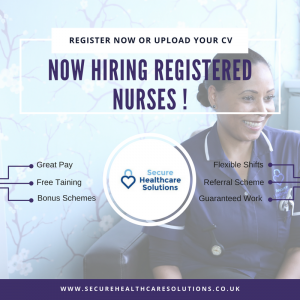
Other Benefits of working with Secure Healthcare – Flexible shifts – Regular shifts – Block bookings – Online timesheets – Dedicated Consultant – Refer a friend scheme – Free Uniform – Meet and Greet (First Shift) – Internal Taxi Service for shifts – Onsite Financial Advice
Looking for a Nursing Job ? … Look no further !
Secure Healthcare can ensure General and Specialist Nurses are placed in a setting that meets their skills, wants and desires on a temporary or permanent basis.
Registered General Nurses
Registered Mental Health Nurses
Registered Learning Disability Nurses
Advanced Nurse Practitioner
Practice Nurse
Pediatric Nurse
Complex Care Nurse
Theatre Nurse
A&E Nurse
Dialysis Nurse
Palliative Care Nurses
School Nurses
Prison Nurses
Respiratory Nurses
Community Nurses
Register with one of the fastest growing nursing agencies in West Midlands
There has never been a better time to join Secure Healthcare Solutions in a full or part time nursing job.
Nursing is a profession within the health care sector focused on the care of individuals, families, and communities so they may attain, maintain, or recover optimal health and quality of life. We specialise in providing nursing jobs in the healthcare industry. We successfully place permanent candidates in their dream jobs and we have a great reputation of placing temporary nurses on an adhoc agency basis. Specialising in Nursing and Care home, mental health, learning disabilities, community nursing, NHS, Private Hospitals and prisons to name a few.
Started in the West Midlands … and growing fast
With offices in Wolverhampton, Birmingham, London, our Nursing Teams have relationships with a huge number of healthcare providers. Whether you’re looking for nurse jobs just round the corner from where you live or further afield, we’ll find the right role for you.
Our relationship with private healthcare providers, NHS mean that we can offer a wider variety of settings to our candidates. Not only general Nurse jobs but also specialist roles such as ITU nursing, Theatre, ODP/ODA, RSCN and pediatric on a temporary and permanent basis.
Competitive pay rates and weekly payments
Rewarding the best; in a rewarding career – We care about and support all our employees. To attract the best candidates, our pay rates are amongst the highest in the industry.
Personalised support
Our Clinical Lead Nurse is here to provide expert advice – from identifying additional training to supporting you to write a reflective statement. We’ll also help you create a Continuing Professional Development Plan.
Training
To enable you to start working as quickly as possible we offer a choice of online modules, in house training or practical training with one of our accredited partners. We’ve recently added a one day Managing and Preventing Aggression (MAPA) course to our in-house options.
We cover nationwide over the whole of the UK and supply to NHS hospitals, private healthcare groups, theatre departments, mental health units and prisons. We have nurse jobs for days, nights or weekend workers, and can accommodate part timers who are only looking for one or two shifts per month or the candidates wanting more.
Looking for a Nursing Job in West Midlands ? … Look no further !
Secure Healthcare can ensure General and Specialist Nurses are placed in a setting that meets their skills, wants and desires on a temporary or permanent basis.
Registered General Nurses
Registered Mental Health Nurses
Registered Learning Disability Nurses
Advanced Nurse Practitioner
Practice Nurse
Pediatric Nurse
Complex Care Nurse
Theatre Nurse
A&E Nurse
Dialysis Nurse
Palliative Care Nurses
School Nurses
Prison Nurses
Respiratory Nurses
Community Nurses
Full-time agency work
Full-time agency workers are welcome, with block bookings and contracts available.
Benefits of working with Secure Healthcare High pay rates Flexible shifts Regular shifts Block bookings Online timesheets Dedicated Consultant Refer a friend scheme Free Uniform Free Training Meet and Greet (First Shift) Internal Taxi Service for shifts Onsite Financial Advice
Nurses who qualify in this branch of nursing help people with learning disabilities to live independent and fulfilling lives. They may work with people in supported accommodation, or with those who need more intensive support – for instance, in hospitals or in specialist secure units for offenders with learning disabilities. There is also the opportunity to specialise in areas such as epilepsy management or working with people with sensory impairment.
You need to complete a pre-registration nursing programme and have excellent communication skills to be a learning disability nurse In this role you will help people of all ages with learning disabilities to maintain their health and wellbeing and to live their lives as fully and independently as possible. You’ll also offer support to their families, carers and friends.
Being a learning disability nurse includes teaching people the skills to look after themselves or to find work, and helping with daily activities such as attending college, going on holiday or out with friends.
You’ll need to draw up care plans and monitor the implementation of recommendations and will work in teams with other nurses and health and social welfare professionals.
As well as helping patients to stay healthy and making sure that they get any medical care they need, you’ll help their families and carers to take breaks when necessary.
Getting Qualified
To work as a nurse in the UK, you must be registered with the Nursing & Midwifery Council (NMC). To become registered, you need to have completed an accepted pre-registration nursing programme and these are only run at NMC approved educational institutions (AEIs).
Pre-registration degrees can be taken in four disciplines:
children (paediatric);
adult;
learning disability;
mental health.
Typically, half of the course is based in clinical practice, giving you direct experience of working with patients and families. You could be based within a variety of settings including hospitals, the community, patients’ homes and independent organisations.
Developing Relevant Skills
You will need to show:
empathy, sensitivity and compassion when working with patients and their families;
flexibility as you’ll be dealing with patients who have a range of needs;
patience in difficult circumstances and because results may not be quick;
assertiveness and the ability to advocate for people with learning disabilities;
emotional resilience;
good communication skills and the ability to gain the trust of people from a range of backgrounds;
ability to work as part of a team.
Taking Responsibilities
The work is mainly based in community or supported living-settings and your tasks may include:
using expert communication skills to engage with vulnerable people;
interpreting and understanding behaviour and evidence-based outcomes to develop individual care packages;
coordinating healthcare reviews/care plans with other health and social welfare professionals, and completing appropriate paperwork;
organising home visits and attending GP clinic appointments to monitor and discuss progress with patients, their carers and their GP;
planning activities, social events and holidays with service users (in supported-living settings);
liaising with hospital admissions staff to plan patients’ care needs on admission and discharge (e.g. housing and medication);
carrying out group work on issues such as problem-solving, anxiety management, healthy living and behaviour management;
supporting staff and carers in the community;
assisting with tests, evaluations and observations;
maintaining awareness of local community activities and opportunities;
supporting the agenda for equality and equal access to all community and public services.
Managing Expectations
Where you work can vary. If you’re based in the community you may be in clinic-type settings and/or spend time visiting patients in their own homes. You could also work with people in supported accommodation or with children in independent and state-funded specialist schools.
Opportunities exist in most major towns and cities, but may be more limited in rural areas.
Most learning disability nurses tend not to wear a uniform but may adhere to a dress code.
The work may be emotionally and physically demanding at times but can also be rewarding when you see the result of your work with a patient.
You could spend a lot of time travelling during a working day, particularly if your service covers a large geographical area.
Working For Good Employers
As a learning disability nurse, you can work in a variety of settings, including services provided by the NHS, social services and private companies. These include:
day services;
private hospitals;
home-based care;
Nursing Homes;
supported accommodation (where five or six tenants live together in a house);
adult education centres;
prisons and detention centres;
workplaces;
specialist schools;
In addition, there are a number of charities and private and voluntary organisations that provide support and accommodation for people with learning disabilities.
Secure Healthcare Services has grown to be one of UK largest private providers of healthcare staffing, in-home support, care and respite services to people with disabilities, ageing people and their families. We can assist our clients in meeting their staffing needs on a permanent,temporary and a contract basis.
Some qualities that helped make us the best staffing service in the west midlands region
Accessibility: We currently employ the best carers and nurses – thanks to our career development plans , free training and top pay packages and we are on call 24 hours a day 7 days a week. If you have an issue after normal business hours, we will always be there to solve the problem.
Reliability: We have built a loyal client following due to our expertise and timeliness in filling open requisitions. Our team of experienced staffing and recruitment professionals are subject matter experts in the business area they serve, and work endlessly to find the right fit for your facility / location.
Tradition: We have been one of the leaders in healthcare staffing for over 25 years. We have developed a deep network of nursing homes, home care professionals and nurses with varying levels of expertise to meet your organisations specific requirements.
For those that don’t know about our company, we are a healthcare staffing agency that specialises in dental, gp, hca and nurse staffing services, allied health staffing services, as well as home care. As a leading provider of homecare, nursing, and allied health personnel in the west midlands, we pride ourselves on our commitment to both the facilities and organisations we help, staff as well as to the community of healthcare professionals we serve to help source the best candidate in the market.
Call us or write to us now, however you feel comfortable and we will to get back to you within 24 hours. Alternatively, if you have any questions or queries about out service, or are interested in any healthcare service we provide, please give us a call on 0121 285 9449
“Higher rates of obesity and ill-health have been found in shift workers than the general population,” BBC News reports.
For years, researchers have been linking long-term insufficient sleep to a host of chronic ills, such as cardiovascular disease, digestive problems, type 2 diabetes, metabolic syndrome and sleep apnea, not to mention the poor concentration, absenteeism, accidents, errors, injuries and fatalities that lack of sleep can cause in the workplace. More recently, studies have associated less sleep with obesity.
Did you know that getting enough sleep can keep you thin?. There are many hormones that are affected by sleep, and most of them control our appetite, fat, carbohydrate metabolism and the growth of lean muscle. Knowing what these hormones do can encourage you to make a greater effort to get the sleep your body needs to keep your weight in control and to improve your overall health.
According to the survey (The Health Survey for England 2013), shift workers were more likely to report general ill-health, have a higher body mass index (BMI) and increased incidence of chronic diseases such as diabetes.
Hormones and Sleep
During sleep, your body secretes serotonin and dopamine. When your body doesn’t get enough sleep, it finds different ways to compensate for the low levels of these hormones while you are awake. The way it typically does this is by sending out signals for sugary foods. These foods cause an immediate release of serotonin and dopamine.
Lack of sleep also increases hormones which increase your appetite. Ghrelin, a hormone that stimulates appetite and makes you feel hungry, is released in excess so that you feel hungry even if your body has enough food. When sleep deprived, your body is slower to release the hormone leptin, which gives you that full, satisfied feeling after eating. The result of these two hormone imbalances is that you crave sugar and still feeling hungry after eating, which leads to overeating.
But that’s not all. Growth hormone, which is responsible for regulating the body’s fat and muscle proportions, is released mainly while sleeping. (If you have kids, you actually may have seen them grow overnight!) Sleep loss decreases growth hormone levels, which in turn slows our ability to burn fat and increase lean muscle.
And one more thing happens when we don’t get enough sleep—lack of sleep can trigger the release of cortisol, often referred to as “the stress hormone.” This hormone promotes the deposit of fat, mainly in the abdominal or belly region.
Preventing Weight Gain
All of this information explains why night shift nurses often experience weight gain. One simple way to combat the disadvantage of working as a night shift is to make sure you come to work with nutritious meals and snacks planned out ahead of time. Also make plans ahead of time for immediately after you get off work so that you are not tempted to grab fast food or go out to eat.
The key to handling night shift hunger is to realise that your natural hunger and fullness cues are not accurate, and to keep to an eating schedule you have planned out in advance.
During a night shift, plan on eating a substantial meal every four hours and one snack. Make the meals on the lighter side, such as a whole wheat calzone made with spinach, bell peppers, sautéed onion and garlic, and low fat mozzarella cheese.
Another good option would be a chicken stir fry with brown or wild rice. Whole wheat pasta with marinara sauce and a few meat balls is also a great choice. Notice in all of these meals whole grains are a big part of the meal. Whole grains will satisfy the craving for carbohydrate, but will keep you from eating too much. Whole grains and vegetables will also keep your bowels regular in spite of a crazy schedule at work.
The Right Amount of Sleep
So how much sleep do you need? While everyone is different, aim for getting an average of 8 hours a night (some may need only 7 hours while some as much as 9).
If you are unsure how many hours you need, do an experiment during a time when you can sleep as much as you want for four nights in a row. Record how many hours you sleep the fourth night. After the fourth night of unlimited sleep, you should be naturally awaking in the morning feeling refreshed. The hours of sleep you received the fourth night will be the approximate hours of sleep you should try to get every night.
Don’t let sleep deprivation for nurses set the stage for over eating and weight gain! Take control starting from tonight!
Do you have other healthy living tips for our night shift nurses friends? Share the love !
Choosing the right people to provide care is vital and Secure Healthcare will help you to make the right choice. From companions and domestics through to highly experienced Carers and Registered Nurses. Following a full analysis of an individuals needs and preferences our experienced advisers will only use staff who they feel are entirely suitable.
We pride ourselves on ensuring persons needing support are Safe, our care treatment and support helps you to maintain quality of life based on best available evidence, our staff involve and treat you with compassion, kindness, dignity and respect. We ensure our services are responsive to your needs and our management ensure high quality care is provided based on an individuals needs.
If you wish to learn more about how we can support you, please contact us and let one of our advisers come to see you and your family for a more detailed plan on how we can support you.
Living independently at home is something most of us would like to do for as long as possible. When that time comes to make the decision to ask for extra support to continue to live independently as much as possible, our home care services are tailored for exactly that.
Tailored Home Care services to meet all your needs
Our trained caring friendly staff have your Dignity and respect at the forefront of delivering personalised care in the comfort of your own home. When providing home care for yourself or a family member or friend, we take the time to get to know you and make sure you are continually happy with the care you received and the staff that support you.
Home care can be arranged on an hourly, daily, weekly basis or a much longer plan to suit your needs. We provides in-home care and support services to people so they can live as independently as possible in their own homes and communities. We support people to live life the way they choose.
The best person to know what support you need to remain as independent as possible in your own home is you. That is why everything we do is designed around your needs and goals. These can be relatively simple like help with shopping through to high dependency 24 hour care.
Housekeeping
Personal care
Companionship
Support with information and advice
Housing support
High dependency care
Live-in care
Respite care
Medication management
Hospital to Home service
Complex and specialist care
What tasks to expect from our Carers and Nurses ?
All our staff can help with personal care (assistance with washing, dressing and toileting), mobility and home management. The UK’s Nursing & Midwifery Council recommends that a qualified Nurse is booked for:
More advanced medical conditions
Management of equipment, e.g. catheters, hoists
Administering (rather than prompting) medication
Wound care, e.g. pressure sores
Professional liaison with local healthcare professionals
Secure Healthcare care can:
Professionally assess your needs
Identify any risk to client or staff (e.g. from manual handling tasks)
Work with your local GP and District Nurse, if appropriate
Create (with your full input) a detailed Care Plan.
If you are still unsure about what type of staff you need please feel free to contact us speak to an adviser or contact your local GP or care professional.
Contact our Homecare Department: Call us on 01902 302017 or write us to homecare@securehealthcaresolutions.co.uk
This website uses cookies to improve your experience. We'll assume you're ok with this, but you can opt-out if you wish. Read More
Cookies are small text files that can be used by websites to make a user's experience more efficient. The law states that we can store cookies on your device if they are strictly necessary for the operation of this site. For all other types of cookies we need your permission. This site uses different types of cookies. Some cookies are placed by third party services that appear on our pages.
Necessary cookies help make a website usable by enabling basic functions like page navigation and access to secure areas of the website. The website cannot function properly without these cookies.
Marketing cookies are used to track visitors across websites. The intention is to display ads that are relevant and engaging for the individual user and thereby more valuable for publishers and third party advertisers.
Preference cookies enable a website to remember information that changes the way the website behaves or looks, like your preferred language or the region that you are in.